|
   

Contents of this page
Which races
populate Uteged?
As you can learn from the climate section on the Planetology
pages, Uteged has very large temperature differences. On the great plain between
Girena and Co maximum temperatures can rise to as high as ninety degrees
Celsius. In contrast, at the higher latitudes in winter the temperature can drop
well below minus sixty degrees Celsius! Four different races have developed to
cope with this harsh climate:
 |
The cool race
This race grows a heavy fur in winter, which disappears in summer. They have
a body temperature of 30 degrees Celsius.
|
|
The hot race
This race lives in an obligatory symbiosis with the heat algae. These absorb
the sunlight and use it for photosynthesis. During this process skin
temperature drops. The hot race has a body temperature of 45 degrees Celsius.
|
|
The indifferent race
This race lives also in symbiosis with the heat algae, but the equilibrium
is precarious at best. The efficiency of heat absorption is much less than with the hot race. When the temperature drops below zero degrees Celsius for any prolonged time, the algae die and revert to
spores.
The indifferent race experiences no ill effects when the algae die, while a
member of the hot race would not be able to survive. Their body temperature
is 37.5 degrees Celsius.
|
|
The southern race
Very little is known about the southwestern continent, knowledge about
its native people is very scarce too. It seems the southern race is very
short and very fat, which makes them suited to living in very cold environments,
but they have no adaptation mechanism to cope with higher temperatures. |
 Top Top
What are the heat algae?
The heat algae are microscopic plants that grow in the skins of the hot and
indifferent races. They absorb sunlight and use it for photosynthesis. During
this process heat is absorbed and the body cools. The algae revert to spores
when the air temperature drops below zero degrees Celsius and they bloom again
when the temperature rises above ten degrees. The hot race is dependant
upon the oxygen production of the algae, so that this species cannot survive
once the algae have died. The indifferent race lives in an uneasy symbiosis with
the algae. Because it is not dependant on the algae's oxygen production it can
survive in the cold seasons in which the algae revert to spores. Frequently the
balance between the algae's invasive abilities and the host's resistance is
disturbed leading to the dreaded algae disease in which the patient develops
large ulcers and dies of dehydration. Furthermore many people of the indifferent
race have an algae allergy resulting in eczema and respiratory complaints. As the algae
spores are ubiquitous, severe allergic patients are best served by living in the
colder latitudes. What is the fur gene?
The fur gene insures that the carrier develops a heavy fur when the
temperature drops below zero degrees Celsius. When the temperature rises above
ten degrees the fur disappears. It is because of this that the northern race,
which is the exclusive carrier of the gene, heats sparingly and feels
quite comfortable at temperatures below ten degrees Celsius. What
happens when the races cross-breed?
| The hot race carries an autosomal dominant algae dependency gene. |
| The indifferent race carries the autosomal recessive algae tolerance gene.
It is located on the same chromosome, so the dependency and the tolerance
gene are mutually exclusive. |
| The cold race carries the autosomal dominant fur gene. |
| results of cross-breeding |
hot race |
indifferent race |
| indifferent race |
| phenotypic hot race, can pass tolerance gene to offspring |
|
| cold race |
phenotypic hot ánd cold race. But can only live in the hot
regions due to the dependency upon the algae. Cross-breeding of hot/cold
race mulattos leads to frequent stillbirths. Many peoples of the cold
race have strong inhibitions toward hot race partners. |
phenotypic cold race, carrier of tolerance gene, but this is
usually not expressed. |
Where
are the races located?
As you see, the indifferent race has gained a lot of
territory through the centuries. This is reflected in the global history, where
you see that in ancient times the hot and cold race civilizations dominate, but
are later superceded by the indifferent race civilizations. This is easily
explained by the fact that, when food production techniques and medical care
improved, the people of Uteged became less dependant upon their racial
characteristics to survive. Indeed the inability of the hot and cold races to
thrive outside their original biotopes put them at a disadvantage as compared to the more versatile indifferent race. In the history section you can read
about some of the more unpleasant consequences this has had in the later
centuries.
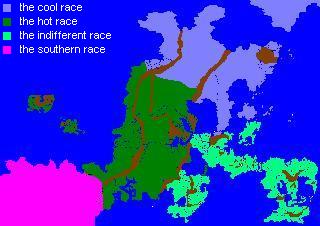
Locations of the races in ancient times
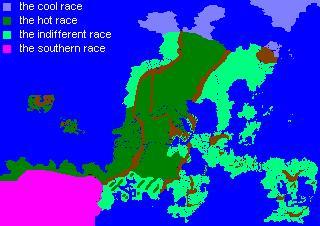
Location of the races in modern times
Top
|



